Article
The Contemplative Crucible: A 7-Day Workshop on Ancient Mind-Training Technologies
May 26, 202610 min read

We live in an era of engineered distraction. Every notification, clickbait headline, and algorithmically targeted alert is a weapon designed to partition our attention and monetize our cognitive drift. For the modern professional, this represents a severe erosion of agency. We assume that our minds are our own, yet we spend our days in a state of perpetual reactivity, dragged from one stimulus to another. To reclaim our sovereignty, we must view attention not as a active state, but as a resource to be actively trained and fortified. Throughout history, the world’s major religions and contemplative schools did not merely offer dogmatic creeds; they developed highly empirical, systematic mental technologies designed to master the human mind. This workshop is a structured, 7-day training crucible designed to demystify these ancient technologies and integrate them into a modern routine for executive performance and profound interior peace.
Before embarking on this training, we must discard our contemporary assumptions about spirituality. Contemplative practices are not about escaping reality, chasing transient emotional highs, or adopting dogmatic beliefs. They are empirical exercises in cognitive engineering. Just as a physical training program stress-tests and builds the muscular system, these ancient mental technologies systematically train specific networks in the brain—such as the frontoparietal control network and the default mode network. By treating these practices as tools rather than dogmas, we can bypass sectarian divisions and access the high-leverage cognitive protocols refined over millennia. This workshop structures these tools into a progressive week-long retreat, moving from physical stability and concentration to radical self-inquiry, emotional resonance, and rational vigilance.
Day 1: Zen Zazen and the Technology of Concentrative Focus
We begin on Day 1 with Zen Buddhism's foundational practice: Zazen, or seated meditation. Zen strip away all metaphysical speculation, demanding a return to direct, physical reality. The objective of Zazen is not to stop thinking, but to build a sieve for attention, training the mind to observe thoughts without clinging to them. The practice begins with physical structure. You must sit on a firm cushion or chair, keeping your spine erect, your shoulders relaxed, and your pelvis tilted slightly forward. This posture is not arbitrary; it represents a physical expression of alert stability, balancing the muscular skeletal structure to allow the respiratory system to operate without restriction. Your eyes should remain slightly open, cast downward at a forty-five-degree angle to avoid both sleepiness and external distraction.
Once the physical architecture is established, focus entirely on the breath. Inhale deeply through the nose into the lower abdomen, and exhale slowly, counting each breath cycle from one to ten. When you reach ten, or if you lose count because of an intrusive thought, return to one. This exercise is deceptively simple, yet it serves as a high-resolution diagnostic tool for the state of your attention. You will quickly discover the hyperactive nature of the default mode network, which constantly pulls you away from the count. The work of Zazen is the gentle, uncompromising return of attention to the breath. Do not fight the thoughts; simply label them as "thinking" and let them pass, like clouds reflecting in a still lake. Complete twenty minutes of this practice today, establishing the baseline concentration required for the rest of the week.
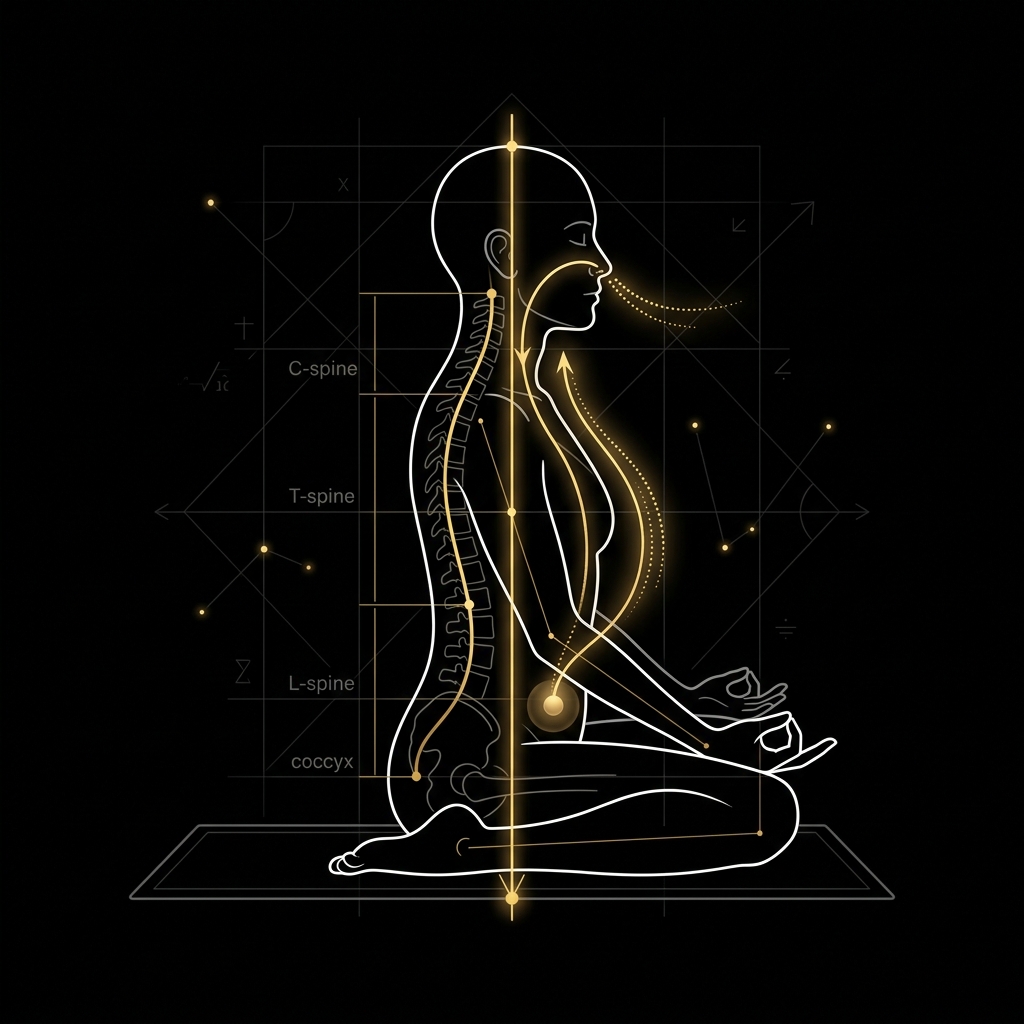
Zen Zazen posture alignment and spinal focus
Day 2: Upanishadic Neti-Neti and the Science of Self-Inquiry
On Day 2, we transition from concentration to self-inquiry, drawing from the ancient Hindu Upanishads and the philosophy of Advaita Vedanta. The core question of this tradition is radical: What is the nature of the "I" that observes our thoughts? Most men confuse their identity with their social roles, their physical bodies, or their passing thoughts. We say "I am tired" or "I am an executive," binding our sense of self to transient, external conditions. The Upanishadic sages developed a systematic negation exercise known as Neti-Neti, which translates to "not this, not that." This practice is designed to strip away these false identifications, revealing the silent, unchanging observer behind our daily experience.
To execute this protocol, sit in silence and direct your inquiry inward. Begin by identifying your physical sensations—the weight of your body, the tension in your shoulders. Consciously observe them, and then state mentally: "I perceive these sensations; therefore, I am not these sensations. I am the observer, not the observed." Next, observe your current emotions—anxiety, irritation, or anticipation. Apply the same logic: "These emotions arise and pass within my awareness; therefore, I am not these emotions." Finally, watch the thoughts themselves as they march through your mind. Realize that because you can watch your thoughts, you are not the thoughts. What remains when all objects of perception are negated is Atman—the pure, unqualified state of conscious awareness. Inhabit this empty, silent space for twenty minutes, realizing that your true self is not a narrative to be defended, but the vast canvas upon which the narrative is painted.
Day 3: Sufi Dhikr and the Rhythmic Resonance of Attention
On Day 3, we explore the mystical heart of Islam through the practice of Sufism, focusing on Dhikr, or the remembrance of the divine. While Zazen and Neti-Neti emphasize cognitive stillness and detachment, Sufism harnesses the power of emotional resonance, rhythm, and vocalization to calm the nervous system and gather the fragmented mind. Dhikr is built on the premise that specific rhythmic sounds and focal phrases, when repeated with absolute devotion, act as an acoustic anchor, aligning the heart rate with the respiratory cycle to induce a state of deep physiological coherence.
For today's workshop session, sit comfortably and synchronize your breathing with a chosen vocal or mental focus. The traditional Sufi phrase is La Ilaha Illallah ("There is no reality but the One"), but you may select any phrase that holds deep, unsentimental meaning for you, such as "Stillness is strength" or "Truth is one." As you inhale deeply, repeat the first half of the phrase internally. As you exhale slowly, release the sound of the second half, allowing the vibration to resonate in your chest. Focus entirely on the physical sensation of the sound and the rhythmic movement of your breath. If your mind wanders, bring it back to the physical vibration. This practice activates the vagus nerve, lowering blood pressure and switching the body from sympathetic fight-or-flight dominance to parasympathetic restoration. Practice this rhythmic focus for twenty-five minutes, feeling your attention consolidate from a scattered spray into a single, resonant beam.
Day 4: Hesychasm and the Silent Guard of the Heart
On Day 4, we examine the contemplative tradition of the Eastern Christian desert fathers, known as Hesychasm (derived from the Greek hesychia, meaning stillness or quiet). The Hesychasts retreated to the wilderness to practice what they called "nepsis"—a state of constant, sober watchfulness over the heart. They viewed the mind as a fortress, and intrusive thoughts as enemy scouts attempting to scale the walls. The technology of Hesychasm is the Jesus Prayer—a brief, rhythmic invocation repeated thousands of times a day to maintain a continuous, defensive guard over awareness.
To apply this practice, you must learn to stand watch at the gates of your mind. Sit in absolute silence, drop your chin toward your chest, and focus your attention on the physical space of your heart. Inhale slowly, reciting the first half of a short prayer or mantra (traditionally, "Lord Jesus Christ, have mercy on me"). Exhale, completing the phrase. The objective is to make the recitation so natural and continuous that it runs as a background program in your mind, occupying the cognitive bandwidth that would otherwise be hijacked by anxiety, comparison, or planning. As you sit, you will observe thoughts trying to enter your awareness. The guard's duty is not to debate these thoughts, but to capture them immediately with the mantra before they trigger an emotional reaction. By maintaining this silent guard for thirty minutes, you develop a powerful buffer between stimulus and response, preserving your cognitive energy for the tasks you choose.
Day 5: Kabbalistic Hitbodedut and Introspective Dialogue
Day 5 introduces a radical contrast to the silence of Hesychasm. We turn to Kabbalah, the Jewish mystical tradition, and specifically the practice of Hitbodedut, popularized by the 18th-century mystic Rabbi Nachman of Breslov. Hitbodedut is the practice of solitary, unstructured, spoken self-expression. Rabbi Nachman advised his followers to go alone to a forest, meadow, or private room, and speak aloud to the source of existence in their native tongue, expressing their fears, regrets, and desires with absolute honesty, as if speaking to a trusted friend.
This practice serves as an extraordinary psychological release valve. In our daily lives, we constantly edit our speech, maintaining a polished persona for our colleagues and families. This constant filtering builds up massive unconscious tension, which manifests as anxiety and physical stiffness. In Hitbodedut, you break this filter. Set a timer for twenty minutes, go to a place where you cannot be overheard, and begin speaking aloud. Do not plan what you will say; simply start talking. Speak about your current stresses, your unacknowledged regrets, your hopes, and your frustrations. If you run out of things to say, state aloud: "I have nothing to say, I am stuck." Keep the verbal stream flowing. By speaking your raw internal dialogue into the physical world, you externalize your conflicts, allowing your conscious mind to observe, process, and release them. This vocal self-inquiry acts as a powerful tool for self-knowledge, clearing the mental deck for deep, unobstructed focus.
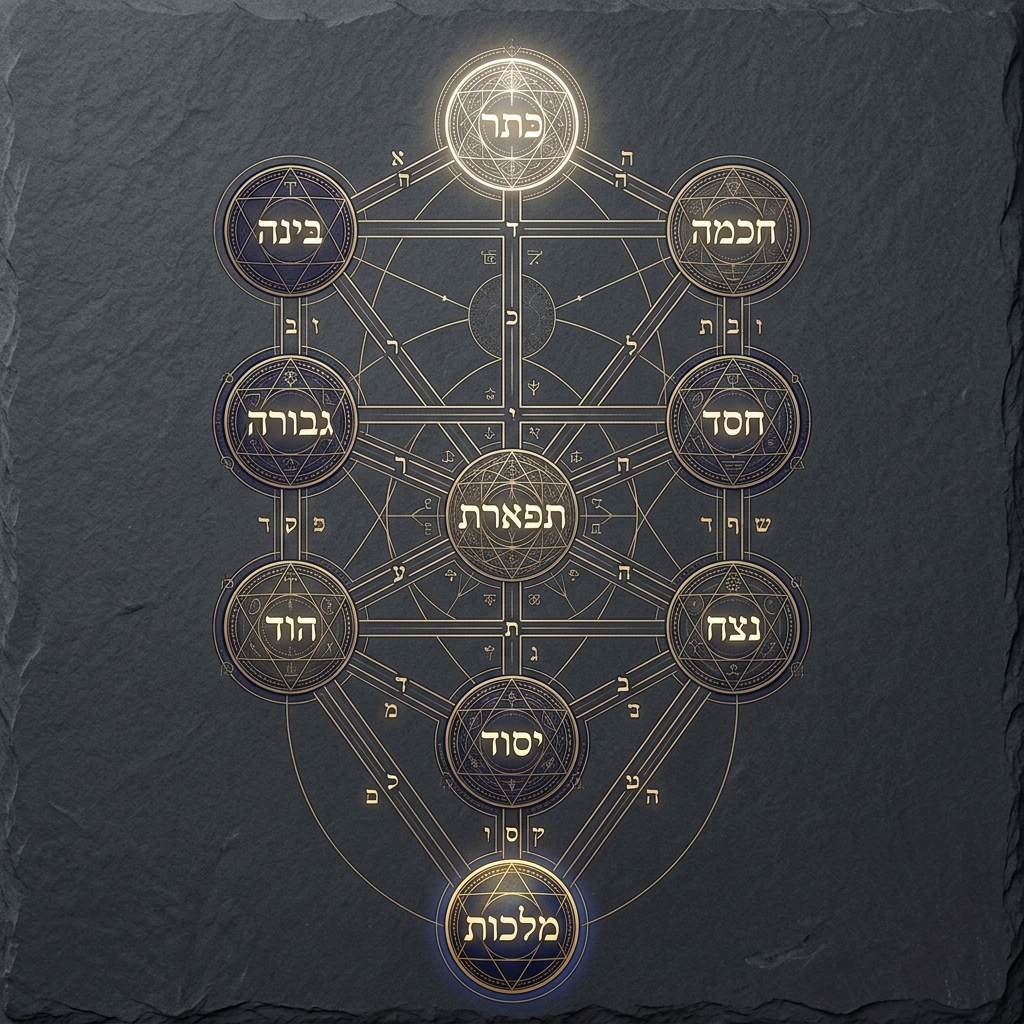
The Kabbalistic Tree of Life (Sephirot) mapping of human consciousness
Day 6: Stoic Prosoche and the Active Audit of the Mind
On Day 6, we transition to a secular, rational technology from the Greco-Roman world: Stoic Prosoche, or active spiritual attention. Marcus Aurelius and Epictetus did not view philosophy as a dry academic exercise, but as a continuous, real-time audit of one's judgments. Prosoche is the practice of standing guard over your mind's evaluations, ensuring that you do not confuse external events with your internal reactions to them. It is the ultimate tool for maintaining poise and agency under pressure.
To practice Stoic Prosoche, you must divide your experiences into two categories: the external facts, and your cognitive interpretations. When an obstacle arises—a business crisis, a difficult email, or a physical injury—apply the Stoic filter. State to yourself: "The event has occurred; that is an external fact. My frustration is an interpretation I am adding to the event. The event itself cannot harm my character; only my reaction can." Complement this audit with Premeditatio Malorum—the premeditation of adversity. Spend ten minutes in the morning visualizing the worst-case scenarios for your day: difficult conversations, delays, or failures. By rehearsing these challenges in advance, you strip them of their novelty and emotional sting. When they occur in reality, you will meet them not with panic, but with a prepared, rational protocol.
Day 7: The Integration Protocol and Your Daily Contemplative Liturgy
We conclude on Day 7 by integrating these 7 distinct contemplative technologies into a unified, sustainable daily routine. The value of these practices is not realized in isolated, week-long retreats, but in their consistent application to the friction of daily life. To maintain your focus and sovereignty in a distracted world, you must design a personalized daily contemplative liturgy—a set of morning and evening routines that act as anchors for your days.
For your morning routine, allocate fifteen minutes immediately upon waking. Begin with five minutes of Zazen to stabilize your attention, followed by ten minutes of Stoic Prosoche and Premeditatio Malorum to mentally rehearse your day and establish your rational guard. For your evening routine, allocate fifteen minutes before sleep. Spend ten minutes practicing Neti-Neti self-inquiry to strip away the stress and identities of the workday, followed by five minutes of rhythmic Sufi breathing to activate the parasympathetic nervous system and prepare the brain for deep sleep. By executing these routines with absolute discipline, you transform your relationship with time and attention. You cease to be a passive consumer of external stimuli, becoming instead the active author of your own consciousness, navigating the world with the clarity of a scholar and the unshakeable resolve of a warrior.
Further Reading & Intellectual Resources
We recommend studying the source texts below to further explore the scientific principles or philosophical arguments detailed in this dispatch.
A History of God: The 4,000-Year Quest of Judaism, Christianity and Islam
by Karen Armstrong
An intellectual, comparative exploration of how monotheism emerged and evolved over millennia.
The Upanishads
by Translated by Eknath Easwaran
Introduces the ancient forest teachings of India, establishing the monistic identity of soul and cosmos.